Brand Identity Design: The Complete Guide for Saudi Arabia and the Gulf (Elements, Prices in SAR, Files)
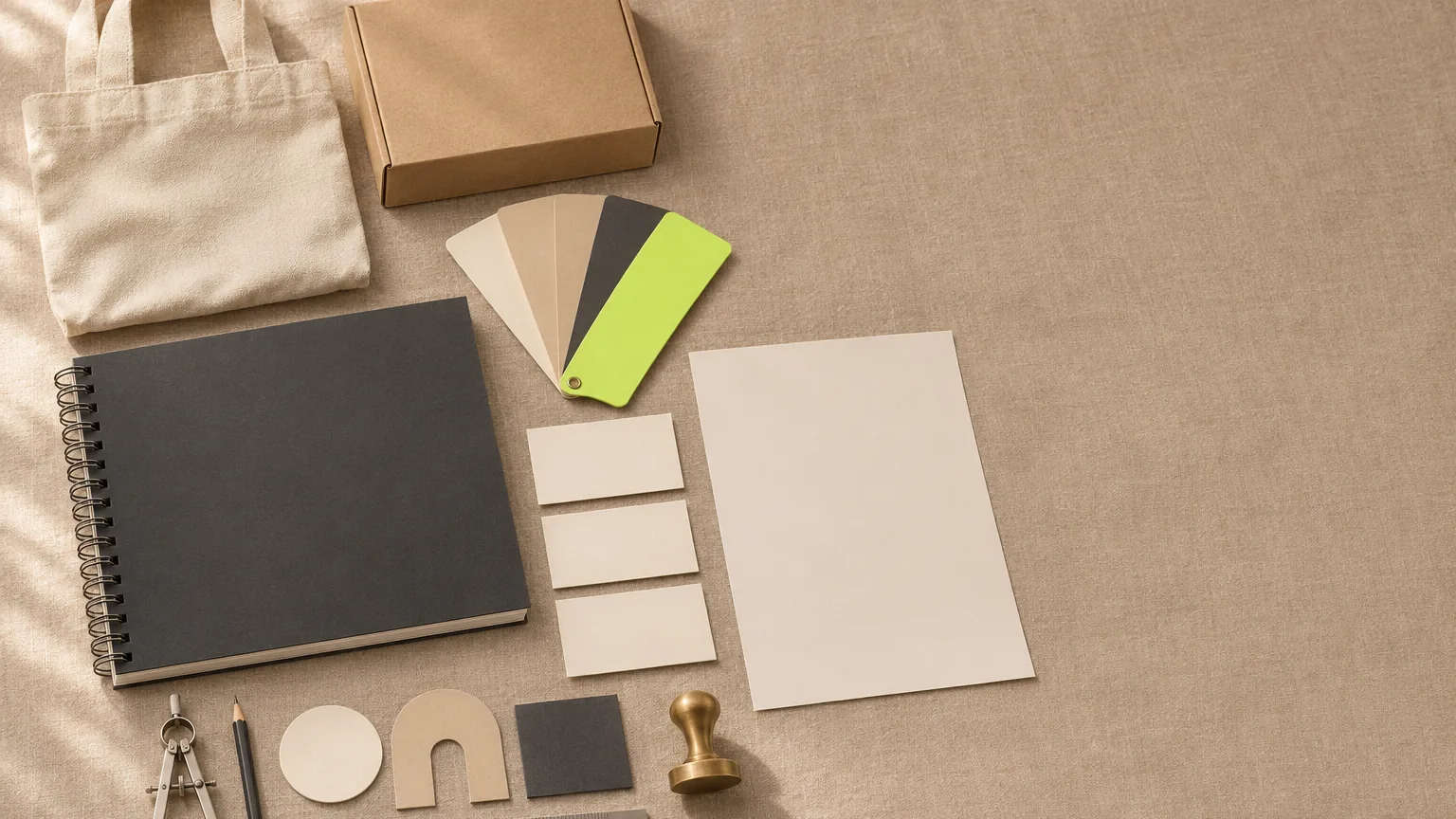
A complete brand identity means you get a system, not just a logo: a logo in several formats, colours, Arabic and Latin fonts, patterns and icons, print and digital templates, and on top of it a guidelines document. In the published Saudi market, prices start at a few hundred riyals for a standalone logo and reach SAR 8,000–20,000 and more for an extended corporate identity. The real difference is in what is delivered, not how pretty the drawing is. Registering your trademark with the Saudi Authority for Intellectual Property (SAIP) is a separate step that costs SAR 6,500 in government fees.
The short answer: what are you actually paying for?
When you search for “brand identity design” you’ll find free tools, freelance marketplaces and agency pages, and you will rarely find a single guide that explains everything neutrally. This guide gathers what you need before you spend a riyal: what an identity includes, how it is produced step by step, what each level costs according to published numbers, how to write a clear brief for the designer, which files you should leave with, and how all of it relates to registering your trademark in Saudi Arabia.
The summary in three points:
- An identity is not a logo. It is a system of logo, colours, fonts, imagery and rules that makes everything you publish look like it comes from one source.
- The price reflects the deliverables. A logo delivered as a single image, and an identity with guidelines and open files, are two different products even if they carry the same name.
- Ownership and files matter more than looks alone. A beautiful identity that you can’t edit, print or register is an incomplete identity.
What is a brand identity? The difference between a logo, an identity and a brand
Many people use the three words interchangeably, but the difference changes the budget and the expectations:
| Logo | Brand identity | Brand | |
|---|---|---|---|
| What is it? | A single visual mark (a symbol, lettering or both) | A coordinated system of visual elements | What the customer feels and says about you |
| What does it include? | The logo in its formats | Logo + colours + fonts + imagery + patterns + rules | Identity + name + tone of voice + experience + reputation |
| How long does it take? | Days | Weeks | Years of accumulation |
| Who makes it? | A designer | A designer, studio or agency | You and your customers, over time |
The logo is part of the identity, and the identity is part of the brand. You can start with the basics (logo, colours, fonts) and expand later, as long as the foundation is designed to grow, meaning it comes with open files and written rules.
A quick test: if you changed the designer of your posts tomorrow, would their work come out with the same colours, fonts and spacing without you explaining anything? If not, what you have is a logo, not an identity.
Why do you need a brand identity at all?
- Quick recognition: people recognise colours and shapes before they read the name, especially on mobile and on the street.
- Trust: a consistent look across your website, social profile, invoice and packaging gives the impression of an organised company.
- Speed of production: with ready templates and rules, you produce posts and presentations in minutes instead of hours of trial and error.
- Protecting your ad spend: advertising on an unstable identity means redoing the work every time it changes.
The elements of a complete brand identity: 12 deliverables you should know
This is the list to compare any quote against. Not every company needs every item, but you should know what you’re buying and what you’re leaving out.
| # | Deliverable | What it includes | Who it matters to |
|---|---|---|---|
| 1 | Logo system | Horizontal and vertical versions and a standalone icon, in full colour and monochrome, on light and dark backgrounds | Everyone |
| 2 | Colour palette | A primary colour, supporting colours and neutrals, with HEX and RGB values for screen and CMYK for print (and Pantone when needed) | Everyone |
| 3 | Fonts | A heading font and a body font in Arabic and Latin, with weights, sizes and usage licences | Everyone |
| 4 | Imagery style | Guidance on lighting, angles and colours, with examples of what to use and what to avoid | Stores, restaurants, real estate |
| 5 | Icons | A consistent set with the same line weight and corners | Websites and apps |
| 6 | Patterns and supporting elements | A repeating pattern or distinctive shape that works without the logo | Packaging and backgrounds |
| 7 | Brand guidelines | Safe space, minimum size, forbidden mistakes, correct examples | Everyone (the most important deliverable) |
| 8 | Stationery | Business card, letterhead, envelope, stamp, invoices, company profile | Companies and offices |
| 9 | Social and digital templates | Profile picture, covers, post and story templates, email signature, presentation | Almost everyone |
| 10 | Packaging | Box, bag, label, tape | Products, food and retail |
| 11 | Signage and wayfinding | Shopfront, interior signs, vehicles | Shops, restaurants and clinics |
| 12 | Bilingual version (lockups) | An Arabic logo, a Latin logo and a combination of the two in controlled proportions | Any brand that speaks to Arabic and English audiences |
Item 12 in detail: the Arabic and English identity together
This is where business owners lose the most when they ask for an English design and then “translate” it. Arabic script has a different visual weight, connection and height from Latin, so:
- The Arabic name and the Latin name are designed together, not one and then the other. Sometimes the Arabic logo is the original and the English one is its visual translation, and sometimes the reverse.
- At least two lockups are prepared: horizontal (Arabic on the right and Latin on the left, or the reverse depending on use) and vertical (stacked), with a stated priority when space is tight.
- Arabic and Latin fonts are chosen to match in weight and personality, and numerals (Arabic-Indic or Western) and punctuation are tested inside mixed-language sentences.
- Templates are reviewed in both directions: icons that point somewhere (arrows, progress, back) must flip in the Arabic version.
- Stretching or distorting letters to fit the logo is avoided; the font loses its legibility.
The steps of identity design: the process from first file to handover
Any serious project goes through these stages, even if designers name them differently. If you don’t see one of them in a quote, ask about it.
- Discovery and brief. You answer questions: who are you, who do you sell to, what sets you apart, who are your competitors. A quarter of the project’s quality is decided here (the ready template is below).
- Market research. Collecting competitors’ and inspiring identities so you know where you stand, how to stand out, and what your customers expect in your market.
- Initial directions. Usually a set number of directions (not dozens) is presented, each with a written rationale rather than just a look.
- Choosing one direction and developing it. Locking the direction early gives a stronger result. Changing direction completely halfway is normally treated as a new project.
- Building the system. The logo in its formats, colours, fonts, icons, patterns and usage rules.
- Applications. Testing the identity on a card, a website, a post, packaging and a sign, because an identity that doesn’t hold up in the real world gets adjusted here.
- Handover and training. The files, the guidelines and a short explanation of how to use them for your team or the printer. Agree in advance on a support period after handover.
Approximate timing according to what agencies publish: a standalone logo takes days, a basic identity two to three weeks, and a complete identity with guidelines and applications up to six weeks. A project usually runs long because of late approvals or missing information, not because of the drawing.
How much does brand identity design cost in Saudi Arabia? The published numbers
There is no single price in the market, but what is published openly gives a clear picture. These are the numbers we could verify as of 8 November 2026:
| Source | What it publishes | Note |
|---|---|---|
| Khamsat platform (first 30 services in the “brand identity design” category) | A “starts from” price of $5 to $100 for the basic service, with a median of $50 (about SAR 188 at 3.75 riyals to the dollar) | A starting price that rises with add-ons and upgrades; the platform itself says the price starts at $5 and increases with the package |
| iCloudITS | Three packages: Basic SAR 3,000, Growth SAR 6,000, Business SAR 11,000, one-off and excluding VAT | One company’s prices, quoted as an example of published packages |
| The same company (a market map it compiled in September 2026 from Saudi companies’ pages) | Logo only SAR 299–1,000 · basic identity 1,500–3,500 · complete identity with guidelines 2,700–7,600 · identity with print items and company profile 5,900–11,000 · extended corporate identity 8,000–20,000+ | A compilation reported by the company; we did not re-check every source in it, so treat it as an indicator, not a rule |
| Hawih studio (Riyadh) | “From a few thousand to tens of thousands of riyals” for a complete identity | An approximate figure with no table |
How to read these numbers
The next table is ours: it summarises what you can usually expect at each level, based on the deliverables published in the sources above, not on prices we invent.
| Level | Published price range (SAR) | What you usually get | What is often missing |
|---|---|---|---|
| Freelancer / entry offer | Under 1,000 | A logo in one or two formats | No identity guidelines, you may not receive open files, and few applications |
| Basic identity | About 1,500–3,500 | Logo + colours + fonts, and perhaps a short guide | Few applications, no exhibition print items |
| Complete identity with guidelines | About 2,700–7,600 | A full system + guidelines + stationery + digital templates | Often no company profile or packaging |
| Identity with applications | About 5,900–11,000 | The above + company profile and wider applications | May be single-language unless you ask |
| Extended corporate identity | 8,000 – 20,000+ | A bilingual system, packaging, signage, rules for several branches | What’s least likely to be missing: enough time for you to approve |
A SAR 300 logo can cost you twice. If it reaches you as a single image with no open vector file, you can’t enlarge it for a sign or separate its colours for printing, and with no guidelines every later designer will start from their own interpretation, so the look falls apart within months and you pay again. A low number isn’t wrong in itself; it suits testing an idea, not building a brand you’ll spend ad money on.
Worked example: what do you pay in the first year for a small project?
A hypothetical project: a start-up store picks a basic identity at a published package price (SAR 3,000), then registers the trademark:
| Item | Amount (SAR) |
|---|---|
| Identity design (published basic package, excluding VAT) | 3,000 |
| SAIP registration application fee | 1,000 |
| Publication fee | 500 |
| Registration and certificate fee | 5,000 |
| Total before VAT | 9,500 |
Notice that the government fees (SAR 6,500) are larger than the cost of the design itself in this example, and that skipping registration to save the money means your brand may not be protected if someone else applies with the same name. VAT is added to the design invoice, so always ask: does the price include VAT?
What raises or lowers the price of an identity?
- Scope of work: a logo only, a full system, or a system with packaging, signage and branches.
- Number of directions and revision rounds: the more of them, the more direct time. Agree on the number in writing; “unlimited revisions” is a phrase that often ends in a project that never closes.
- Languages: an Arabic and English identity designed together takes more time than one language, and it’s time worth paying for.
- Applications: the number of printed items, templates, packaging and signs.
- Research and strategy: does the designer ask questions, research the market and write the rationale for the directions, or just show ready-made shapes?
- Experience and documentation: who does the work, and whether originality is documented in the contract.
- Ownership rights and files: open files and full rights require an explicit agreement; some cheap offers keep the right of use or don’t hand over the source.
- Urgency: a shorter timeline usually means a smaller scope or an extra fee.
DIY, freelancer or agency? An honest comparison
| Self-service tool (Canva and similar) | Freelance designer (Khamsat and others) | Agency / studio | |
|---|---|---|---|
| Price | Free or a subscription, plus your time | From hundreds of riyals to a few thousand | Thousands to tens of thousands |
| What you get | Templates, elements and AI-assisted ideas | Output as agreed, varying widely | Strategy, design, applications, guidelines and support |
| Uniqueness of the design | Shared templates that may resemble others | Varies by designer | Usually documented in the contract |
| Guidelines and files | Depends on your plan and what you build yourself | A full guide is rarely delivered; ask for it explicitly | Usually delivered with open files |
| Arabic typography and market understanding | Limited to what the tool offers | Varies | Usually part of the expertise you’re hiring |
| Best for | Testing an idea or a very small project | Limited-size work, if chosen well | A brand that will grow and spend on advertising |
A practical tip: if you choose a self-service tool, use it as a thinking draft, then decide. If you choose a freelancer, choose one with work like what you need (complete identities, not just logos), and read the reviews of buyers who actually received source files.
How to write a brief for the designer: a ready template
A good brief saves you revision rounds and raises the quality of the work more than any extra payment. Copy this template and fill it in:
- About: project name (Arabic/Latin), business, city, year founded.
- What do we sell and to whom? The target audience (age, city, interests).
- What sets us apart from competitors? (One sentence)
- Three qualities we want the brand to feel like (for example: calm, trustworthy, modern).
- Three qualities we avoid (for example: loud, too traditional).
- Identities we like (3 links) and why. Identities we don't like (a link) and why.
- Colours we prefer or avoid. Do we have a logo or a name that won't change?
- Languages: Arabic only, or Arabic + English? Which one is primary?
- Where will the identity appear? (shopfront, packaging, website, invoices, vehicles...)
- Required deliverables: (logo versions, guidelines, stationery, social templates...)
- Files: open files + SVG + PDF + PNG, and full transfer of ownership.
- The agreed number of initial directions and revision rounds.
- Budget and deadline, and who approves decisions (one person).
The biggest accelerator is one person who approves decisions and a clear idea of the audience. Too many opinions inside the team is among the most common reasons identity projects stall.
The list of files you should receive (before you pay the final instalment)
| File | Format | Why? |
|---|---|---|
| Open source files for the logo and identity | AI or vector PDF or equivalent | So you or any later designer can edit them |
| Digital logo | SVG and PNG with a transparent background | For the website, apps and social media |
| Logo for print | Vector PDF or EPS | To enlarge to any size without losing quality |
| All logo versions | Horizontal, vertical, icon, full colour, monochrome, white | For every background and context |
| Colour values | HEX, RGB, CMYK (and Pantone if needed) | So screen and press match |
| Font list with licences | Font names and weights, and the font files if the licence allows | Some fonts are free for screen only or not allowed commercially |
| Identity guidelines | The usage rules | |
| Application templates | Editable (and PDF for print) | Card, letterhead, presentations, social templates |
| Ownership sheet | A clause in the contract | Confirmation that the rights have passed to you |
Don’t accept a single image in a single format. And before final handover, make sure the fonts used are licensed for your commercial use (screen, print and apps), because using an unlicensed font can expose you to a claim later. Ask explicitly: are the fonts commercially licensed?
Trademark registration in Saudi Arabia: how does design relate to it?
Design doesn’t give you legal protection by itself; registration does. According to the “Register a trademark” page on the Saudi Authority for Intellectual Property (SAIP) website as of 8 November 2026:
- Fees: SAR 1,000 for the registration application, SAR 500 for publication, and SAR 5,000 for registering the mark and issuing the certificate (SAR 6,500 in total).
- Stated processing time: 90 days.
- Stages: submit the application through the unified intellectual property platform, then examination of the application, then a decision to accept, accept subject to amendment (a 90-day window) or reject, then publication for 60 days, then payment of the final invoice within 30 days and printing the certificate.
Tips for the designer and the client:
- Ask the designer for a similarity search before approving the name and logo, and check the trademark database yourself.
- A logo built on a shared template or an automatic generator is more likely to resemble other marks.
- Register the logo you will actually use, in its final form; changing it after registration means a new application.
- This paragraph is general information, not legal advice; for complicated cases, consult an intellectual property agent.
Common mistakes in brand identity design
- Starting with the logo before the strategy: you don’t know who you’re designing for or what sets you apart.
- Relying on an automatic tool for the whole identity: it gives a good result as a draft, but usually with no guidelines and no professional files.
- Not asking for open files and ownership in writing: you find out later that you can’t edit anything.
- An English identity “translated” into Arabic: the visual balance and legibility suffer.
- Colours that don’t survive printing: approved on screen, then different at the printer; ask for CMYK values and test a print.
- Too many colours and fonts: one primary colour, two or three supporting colours and two fonts are enough.
- A logo that doesn’t shrink: test it at phone-icon size and stamp size.
- Fonts without a commercial licence.
- Multiple decision-makers: it delays the project and weakens the result.
- Not registering: you invest in a brand you may not be able to protect.
A checklist before you sign the quote
- Are the deliverables written out item by item?
- How many initial directions, and how many revision rounds?
- Does it include the Arabic and English versions together?
- Does it include open files and a guidelines document?
- Who owns the rights after handover?
- Are the fonts commercially licensed?
- Does the price include VAT?
- What is the timeline, and what do you need to deliver for it to start?
- What support is there after handover?
How can Qotora help?
Qotora is a full-service digital team working with brands in the Gulf and around the world. Our services include brand identity, and designing websites and online stores. In identity work we focus on a point many people neglect: an Arabic and English identity designed together, with an Arabic and Latin logo, bilingual lockups, fonts chosen for both languages and templates that work in both directions.
How we work: a free first consultation in which we understand your business and your audience, then a written fixed quote that sets out the deliverables, the number of rounds and the timeline, with full transfer of ownership and open files. We don’t promise sales results; we promise a clear system that you can apply and extend. We communicate in Arabic or any language you prefer.
Sources and method. Trademark fees, processing time and stages: Saudi Authority for Intellectual Property - Register a trademark. Starting prices on Khamsat - brand identity design (the first 30 services listed, a "starts from" price, converted at 3.75 riyals to the dollar). Agency packages and prices: iCloudITS - brand identity design and brand identity packages; definitions of the elements from Hawih - brand identity elements and the cost of a logo and an identity; examples of the self-service tool from Canva. Published figures may change with their owners and are not quotes. The analytical tables (what you get at each level) are our summary of the published deliverables and are not Qotora prices. The exchange rate of 3.75 riyals to the dollar is approximate and was not verified against an official source in this review, and the VAT rate should be checked with the Zakat, Tax and Customs Authority. Last checked: 8 November 2026.
Frequently asked questions
What is the difference between logo design and brand identity design?+
A logo is a single visual mark. A brand identity is a complete system: the logo in its formats, the brand colours and fonts, the style of imagery, icons and patterns, and how they apply to print and digital platforms, all held together by a guidelines document. The brand itself is the full impression your customer carries of you, and it includes the identity, the voice, the experience and the reputation.
How much does brand identity design cost in Saudi Arabia?+
There is no single price. What is published openly runs from a few hundred riyals for a standalone logo to more than SAR 20,000 for an extended, multilingual corporate identity. Starting prices on the Khamsat platform begin at about $5 per offer, and one Saudi agency publishes packages of SAR 3,000, 6,000 and 11,000 excluding VAT. Always compare the list of deliverables, not the number alone.
What are the elements of a brand identity?+
The logo in its formats (horizontal, vertical, icon, full colour, monochrome), the colour palette with values for screen and print, Arabic and Latin fonts, the style of imagery, icons and patterns, the guidelines document, and then the applications: business card, stationery, social media templates, packaging and signage.
How long does brand identity design take?+
A standalone logo can take days. A basic identity usually takes two to three weeks, and a complete identity with guidelines and several applications can take six weeks or more. What sets the timeline is how fast you approve each stage, how many revision rounds there are and how ready your business information is.
Can I design my identity myself with Canva?+
Yes, for a simple start or a pilot project. But keep in mind that templates are shared by thousands of users, so the result may look like someone else's, it may be hard to register as a trademark, and you will usually not get a guidelines document or vector files ready for professional printing. Check your plan and the licensing terms before relying on it commercially.
Which files should I receive after the design?+
The open source files (AI, vector PDF or equivalent), the logo in SVG, PDF and PNG with a transparent background in all its versions, the colour values (HEX, RGB, CMYK and Pantone if needed), the list of fonts with their usage licences, the identity guidelines as a PDF, editable application templates, and an explicit clause in the contract transferring ownership to you.
How much does it cost to register a trademark in Saudi Arabia?+
According to the service page on the Saudi Authority for Intellectual Property website: SAR 1,000 for the registration application, SAR 500 for publication, and SAR 5,000 for registering the mark and issuing the certificate, so SAR 6,500 in total, with a stated processing time of 90 days. Confirm the current fees on the official website before you apply.
 Buyer's guide How to Choose a Digital Marketing Agency in Dubai: A Buyer's Guide With a Weighted Scorecard
 Practical guide How to Create an Online Store in Saudi Arabia (2026): The Full Guide from Idea to First Order
 Pricing guide Ecommerce Website Cost in Dubai: What an Online Store Really Costs in 2026